|
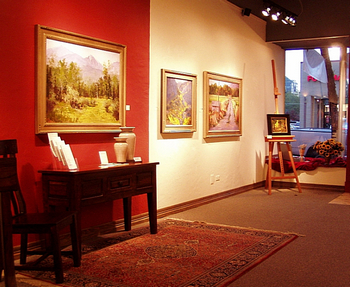
Profile: Note: If you are a gallery, member of the media, or other person interested in a text and/or graphical presentation of this general information and profile, please call or email for a .pdf version. Also, call with your word count requirements if you need a condensed version of this information. General Information About the Artist John Passaro paints and draws commissioned portraits, creates figurative work, still lifes, subjects from the animal kingdom, and architecture. For many years he painted landscapes from life and then painted larger, more-developed works from the outdoor studies. His artwork is held in five corporate collections in Colorado and literally hundreds of private collections all over the United States, as well as places as far away and diverse as Canada, Mexico City, Germany, Scotland, and the Dominican. John Passaro owned and operated Terra Firma Fine Art Gallery on Broadway in Denver for nearly five years and then owned Alpine Fine Art Gallery in Denver's Santa Fe Drive Art District for fourteen years. He maintained a studio in the back of both commercial galleries and sold his own work, other artists' work, bought and sold estate artwork, and hosted shows and events for innumerable art associations in the Denver area and Colorado. "Operating galleries opened unlimited opportunities to meet people, make friends, and create. It was fun and challenging, and the one thing I knew for sure was it was impossible to predict who would walk through the door and buy a painting. One of my teachers used to say that his teacher told him, 'A good painting will always find a good home.' And it's amazing the places a good painting from Denver end up . . . my work is in a castle in Bavaria, a really nice home overlooking the river in Edinborough, and even the presidential palace in the Dominican. I began more than forty years ago in school painting figures and portraits, then spent the majority of my artistic life painting landscapes, especially outdoors. Eventually I became more interested in drawing outdoors rather than painting as a means of gathering information for work. In the studio, the images and information from life turned into increasingly more expressive works and, at times, became less and less representational."
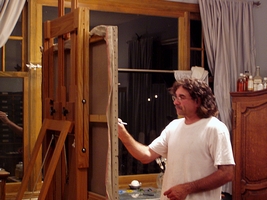
The Value and Challenge of Craftsmanship John Passaro has a lifelong commitment to the craftsmanship side of art. He studied at the old Rocky Mountain School of Art in Denver, spent countless hours as a teen-ager drawing at the Chicago Art Institute for a summer and fall, and eventually studied at the Museum of Fine Arts School in Boston where he spent many hours copying paintings in the Museum's permanent collection in the traditional manner and learning the traditional skills. "I met a great man and great teacher named John Burns at the Museum School. He taught us how to take a painting from the ground up, stretching raw linen, boiling rabbit skin glue as size in double boilers, and making our own gesso in the same manner (and with many of the same materials) as in the Renaissance, how to make varnish, how to make different kinds of mediums for painting, everything. To this day I can do all those things, but of course there's no reason to. I'm proud that I can, though." At one point he had memorized most of Ralph Mayer's book on materials and techniques, and he still knows and understands the composition of every paint and medium around. "Don't get me started on the characteristics and material qualities of artist materials unless you have a lot of time on your hands." He learned to paint outdoors at the Art Students League of Denver. "I relied on the patience of my mentor without mercy. He said most students paint five hundred paintings to get to the point where you might know what you're doing. That was me, and then some, and the man critiqued every one of more than five hundred I'll bet. They were hideous, but eventually I caught on."
And? "Nobody told me learning would be the easy part compared to what comes next. Every artist who gets competent in the basics is faced with the same question of course: 'What do I do now with what I've learned?'"
|